Planning a kids birthday party is a different skill set than planning an adult party. The food quantities are smaller, the timelines are shorter, the activities need to be structured and age-specific, and the stakes around food allergies are higher. A 2-hour party for twelve 6-year-olds requires more active management than a 4-hour cocktail party for thirty adults — because children do not self-entertain at parties the way adults do, and the difference between a structured 30 minutes and an unstructured 30 minutes is the difference between a memorable party and controlled chaos.
The calculator above handles food quantities for any age group and guest count — scaled for children who eat smaller portions and designed around the pizza-and-snacks format that works at most kids parties. The 70-task checklist covers the full planning timeline from 6 weeks out through the final moment of handing favor bags to departing families at the door.
Lock in the big decisions early — venues and entertainment book fast
0/10▼
🗓️ 2–3 Weeks Before
Finalize guest count, buy decorations, and plan food
0/10▼
🛒 1 Week Before
Shop, prepare, and confirm everything possible
0/10▼
🌙 Day Before
Prep everything possible — party morning is always chaotic
0/10▼
🎉 Party Day — Setup & Flow
Arrive early, build in transition time, keep energy manageable
0/12▼
🌡️ Food Safety & Allergy Management
Children’s parties require extra care — allergies are common and serious
0/10▼
🎮 Activities & Games by Age
A structured activity plan prevents party chaos
0/8▼
Food Allergies and Choking Hazards — What Every Host Needs to Know
Food allergies at children’s parties are significantly more serious than at adult events, and they are significantly more common. The FDA identifies nine major food allergens, and peanut and tree nut allergies are among the most prevalent in children — and the most likely to trigger severe anaphylactic reactions. The most important step is asking about allergies on the invitation when parents RSVP, not after the menu is planned. Collecting this information early gives you time to source appropriate alternatives and set them up in clearly labeled, separate containers with dedicated serving utensils.
The choking hazard issue is separate from allergies but equally important for parties that include children under four. Common party foods that pose choking hazards for young children include whole grapes, cherry tomatoes, hot dogs, and large chunks of firm vegetables or fruit. All of these should be cut into small pieces before serving to a mixed-age group. Toddler supervision around the food table is essential — a child can pick up a piece of food while an adult is three feet away managing a different situation.
The Activity Plan and the Cake Moment
The activity plan is where most kids parties either succeed or fail. A 2-hour party for children ages 4 to 7 needs three to four structured activities — not suggestions or stations, but actual guided activities with a clear start, middle, and end. Musical Chairs works not because it is the most inventive game but because it has clear rules, a clear winner, and a built-in mechanism that manages the group. The critical addition for any competitive game at this age group is prizes for all participants — not just the winner. Children who do not win have significant emotional reactions that can derail the energy of the entire party if the host is not prepared for it.
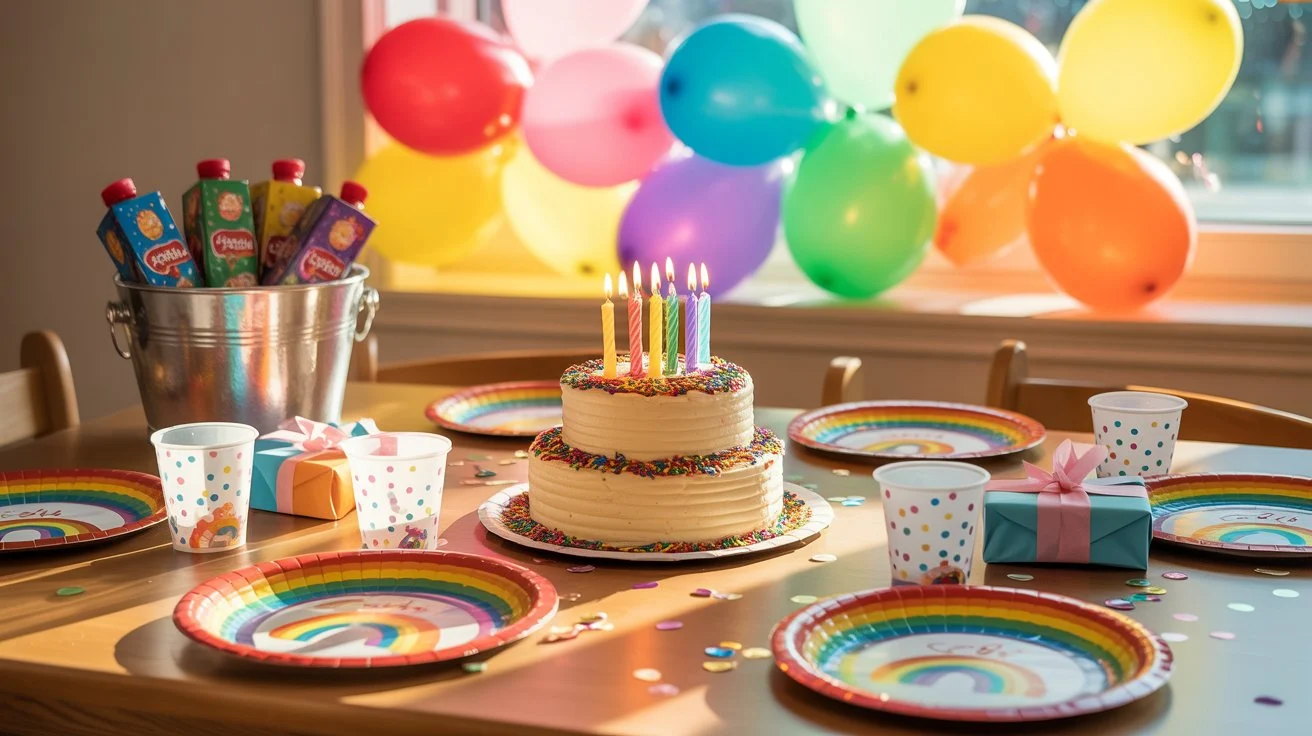
Keep the birthday cake out of sight until the exact moment you are ready to bring it out with candles lit. Children who can see the cake will ask about it every five minutes for the entire party. The reveal should be a moment — lights dim, everyone gathers, the cake arrives with candles already lit and the song already starting. Move through the candle-blowing, cutting, and serving efficiently. Children who have been building anticipation for 90 minutes are at their least patient precisely when the cake appears.
Reader Favorite
🍫 The Ultimate No-Bake Dessert Ebook 🍓
30 mouthwatering no-bake recipes you can whip up in minutes — creamy cheesecakes, fruity parfaits, chocolatey bars, and more!
Instant digital download • Secure checkout on Gumroad
Frequently Asked Questions
How much food do you need for a kids birthday party?+
For a 2-hour party with lunch, plan 2 pizza slices per child (young children may eat 1, older children 3), snack bowls, a fruit platter, and a veggie tray. For drinks, plan 1.5 juice boxes per child per hour plus water. For cake, plan one slice per person including parents, plus 10 percent extra. The calculator above scales everything for your specific age group and guest count.
How long should a kids birthday party last?+
Toddlers (1–3): 1 to 1.5 hours. Ages 4–7: 2 hours — the sweet spot for structured activities, food, and cake without overtiring young children. Ages 8–12: 2 to 3 hours. Teens: 3 hours or more. A clear end time on the invitation is appreciated by parents, especially those with younger children who need naps or early bedtimes.
How many kids should you invite to a birthday party?+
A common guideline for young children: invite the child’s age in guests — a 5-year-old invites 5 friends. For school-age children, 8 to 15 guests is typical for a home party. Venue parties with structured activities (trampoline parks, art studios) handle larger groups well because the venue manages the activity. Always check your school’s policy before distributing invitations during school hours.
What are the best kids birthday party activities by age?+
Toddlers: sensory play, bubbles, parachute games, free dancing. Ages 4–7: Musical Chairs, treasure hunt, freeze dance, pass the parcel (one prize in every layer). Ages 8–12: relay races, scavenger hunt, trivia, team challenges, DIY craft. Teens: photo booth, DIY food station, escape-room challenge. Every age benefits from at least one backup activity — something always ends faster than planned.
How do you handle food allergies at a kids birthday party?+
Ask about allergies on the invitation when parents RSVP. The most common childhood allergens are peanuts, tree nuts, dairy, eggs, wheat, soy, and fish. Prepare allergy-safe alternatives in completely separate labeled containers with dedicated utensils. Label all food items. For children with severe allergies, ask parents if they prefer to bring their own food — it is a simple, appreciated gesture. Children are more vulnerable to foodborne illness than adults, and severe reactions can be life-threatening.
How many juice boxes do you need for a kids birthday party?+
Plan 1.5 juice boxes per child per hour. For a 2-hour party of 15 kids, that is approximately 45 juice boxes. Also have water available for kids who prefer it and for parents. Keep juice boxes in a cooler — chilled juice boxes are significantly more popular with children than room-temperature ones.
When should you send kids birthday party invitations?+
3 to 4 weeks before the party. Include: date, start and end time, location, RSVP deadline, theme, whether gifts are expected, and a note asking parents to mention food allergies when they RSVP. Check your school’s policy before distributing invitations at school — many require inviting the whole class or all same-gender students if handing out during school hours.
What should be in a kids birthday party favor bag?+
One small toy or activity item, a few stickers, and one or two pieces of candy. Budget $3 to $6 per bag. Quality over quantity — one good item is remembered longer than ten cheap ones. Label each bag with the child’s name to prevent arguments. For art parties, the child’s finished artwork is the favor — no separate bag needed.
🎈 Kids Party Essentials We Recommend
The supplies that make a kids birthday party run smoothly — all on Amazon.
🎂
Themed Birthday Plates & Napkins Set
A coordinated tableware set with themed plates, napkins, and cups eliminates the mismatched party supply problem. Look for a set that includes enough for your guest count — 24-piece sets are common.
Pre-filled favor bags save hours of assembly time. Look for a pack sized to your guest count with age-appropriate toys, stickers, and small treats. Most packs include enough for 12 to 24 children.
A DIY balloon garland kit with strip, pump, and glue dots — no helium needed. A balloon arch at the food table or photo spot makes an immediate visual impact and can be assembled in 1 to 2 hours.
A party game bundle with ring toss, bean bag toss, and a parachute — covers the activity portion of the party without extensive setup. Works for ages 3 to 10 and requires no experience to run.
A pull-string piñata is safer than a traditional blindfolded bat piñata for young children — each child pulls a ribbon and one releases the candy. Fill with candy, small toys, and stickers (sold separately).
A birthday crown or tiara plus a “Birthday Star” sash for the birthday child — makes them feel genuinely celebrated and is instantly recognizable in photos. Available in every color and theme combination.