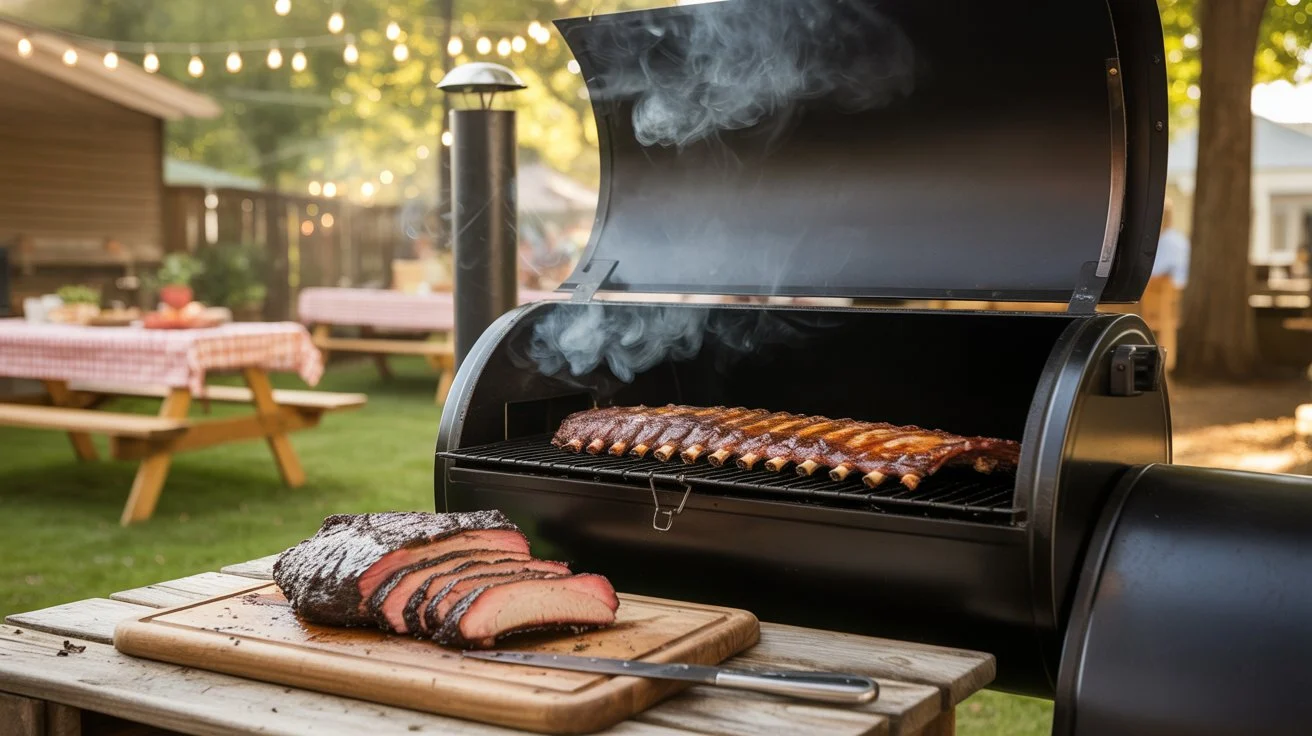
BBQ Cookout Calculator | How Much BBQ Do I Need? + Complete Cookout Checklist
A backyard BBQ cookout is a different undertaking than throwing burgers on the grill. Low-and-slow cooking on large cuts of meat involves timing in hours rather than minutes, temperature management across a multi-hour fire, and food safety considerations that are significantly more complex than a standard cookout. The calculator above handles how much meat to buy for any guest count and cut. The 68-task checklist below handles everything from the dry rub the night before to the fire safety rules that most people overlook.
Two sets of guidelines inform this checklist. USDA Food Safety and Inspection Service guidelines on safe minimum internal temperatures and the danger zone apply to every BBQ event, regardless of size. National Fire Protection Association guidelines on grill clearance and fire safety apply anytime you are running a high-temperature fire outdoors. Both are cited throughout.
Use the calculator above for exact meat quantities
0/10▼
🌙 Day Before — Seasoning & Prep
Most BBQ meats need 12–24 hours of resting after the dry rub
0/10▼
🔥 Grill & Smoker Setup
Low and slow is the foundation of real BBQ
0/10▼
⏱️ Cooking Process & Temperature Targets
Internal temperature — not time — is what determines doneness
0/12▼
🌡️ Food Safety USDA
Outdoor BBQ events have heightened food safety risk — high temperatures accelerate spoilage
0/10▼
🚒 Grill & Fire Safety NFPA
Grill fires cause an estimated 10,600 home fires annually in the US
0/8▼
🍽️ Serving & Presentation
A well-organized serving station makes the event run smoothly
0/8▼
Understanding the Stall — What It Is and What to Do
Every BBQ pitmaster has an opinion on the stall — the period during long cooks where the internal temperature of a large cut stops rising and plateaus between 150°F and 170°F for what can feel like an eternity. The stall is caused by evaporative cooling: moisture evaporating from the meat’s surface dissipates heat at the same rate that the smoker adds it. The temperature is not stuck — it is balanced. It will eventually tip and begin climbing again as the surface dries. The only question is whether you wait it out or use the Texas Crutch: wrapping the meat in foil to trap moisture, end evaporative cooling, and push through the stall in 30 to 60 minutes rather than 2 to 4.
The trade-off of wrapping is real. Foil traps moisture and accelerates cooking, but it also softens the bark — the crust of seasoned, smoked exterior that experienced pitmasters spend hours developing. Butcher paper is a middle-ground option that breathes more than foil, allowing some moisture to escape while still protecting the meat and accelerating slightly through the stall. If bark is a priority, skip the wrap and be patient. If finishing time is a priority, wrap in foil at the stall.
USDA Temperature Guidelines and NFPA Fire Safety
Per USDA Food Safety and Inspection Service guidelines, the minimum safe internal temperatures for BBQ meats are: 165°F for all poultry, 145°F for whole muscle pork cuts with a 3-minute rest, and 160°F for all ground meats including sausage. These are food safety minimums — separate from the tenderness targets that make BBQ worth eating. A pork shoulder at 145°F is food-safe but will not pull. It needs 195°F to 205°F for the collagen to convert to gelatin and produce the texture BBQ is known for. Both temperatures matter: safety and texture are separate considerations, and in BBQ you will almost always exceed the safety minimum before reaching the texture target.
The NFPA reports that grills cause an estimated 10,600 home fires annually in the United States, with a peak in the summer months when outdoor cooking is most common. The organization recommends positioning grills and smokers at least 10 feet from any structure, deck railing, or overhanging branch — a clearance that is ignored at most backyard cookouts. The Consumer Product Safety Commission separately warns that charcoal grills produce carbon monoxide at concentrations that can reach fatal levels in enclosed or partially enclosed spaces within minutes. The rule is absolute: charcoal and wood smokers are outdoor-only equipment.
Reader Favorite
🍫 The Ultimate No-Bake Dessert Ebook 🍓
30 mouthwatering no-bake recipes you can whip up in minutes — creamy cheesecakes, fruity parfaits, chocolatey bars, and more!
Instant digital download • Secure checkout on Gumroad
Frequently Asked Questions
How much BBQ meat do I need per person?+
Plan half a rack of ribs (3–4 bones), half a pound of raw brisket, one-third pound of raw pork shoulder (yields ~¼ lb cooked pulled pork), half a pound of bone-in chicken, or 1 to 1.5 links of sausage per adult. Always buy 10 to 15 percent extra as a buffer. The calculator above scales all quantities for your guest count and appetite level.
What temperature should BBQ meats be cooked to?+
Per USDA FSIS guidelines: poultry must reach 165°F; pork must reach 145°F with a 3-minute rest; ground meats and sausage must reach 160°F. For BBQ-specific tenderness beyond safety minimums, brisket and pulled pork are typically cooked to 195–205°F where collagen converts to gelatin, and ribs to 195–203°F. Food safety minimums and BBQ texture targets are different — both matter.
How long does it take to smoke a brisket?+
At 225 to 250°F, plan 1 to 1.5 hours per pound — a 12-pound brisket takes 12 to 18 hours. Expect a stall at 150–170°F internal where the temperature plateaus for 2 to 4 hours as evaporative cooling matches the heat input. Wrapping in foil at the stall (the Texas Crutch) shortens this significantly. Always rest brisket at least 1 hour before slicing — up to 2 hours for best results.
How long does it take to smoke ribs?+
Baby back ribs at 225°F take 4 to 6 hours using the 3-2-1 method: 3 hours smoke unwrapped, 2 hours wrapped in foil, 1 hour unwrapped with sauce in the final 20 minutes. Spare ribs take 5 to 7 hours. Ribs are done at 195–203°F internal, or when the bend test shows significant flex and the bark cracks.
How far should a grill be from a house?+
The NFPA recommends at least 10 feet from any structure, deck railing, or overhanging branch. Grills cause an estimated 10,600 home fires annually in the US. Never use a charcoal grill or smoker indoors or in a garage — the CPSC warns that charcoal produces carbon monoxide at levels that can be fatal in enclosed or semi-enclosed spaces within minutes.
How much brisket do I need for 20 people?+
Plan 10 to 12 pounds of raw brisket for 20 adults (with buffer). Brisket loses 40 to 50 percent of its weight during smoking, so 10 pounds raw yields 5 to 6 pounds cooked — about a quarter pound per person, which is a standard BBQ portion. A 12-pound packer brisket serves 12 to 14 people, so for 20 guests you need two brisket flats or one full packer plus a flat.
How do you know when pulled pork is done?+
Pulled pork is done when it reaches 195 to 205°F internal and feels probe-tender — a thermometer probe slides in with almost no resistance. At this temperature, collagen has converted to gelatin, producing the characteristic tenderness. Per USDA guidelines, pork is food-safe at 145°F, but it will not be tender enough to pull until 195°F or above.
How long should you rest BBQ meat before serving?+
Brisket: at least 1 hour, ideally 2 (wrap in butcher paper, place in a towel-lined cooler). Pulled pork: at least 30 minutes before shredding. Ribs: 10 to 15 minutes. Chicken: 5 to 10 minutes. Resting allows muscle fibers to relax and juices to redistribute — a brisket sliced immediately loses significantly more juice than one that has rested properly.
🔥 BBQ Essentials We Recommend
The tools that make BBQ more consistent and safer — all available on Amazon.
🌡️
Wireless Leave-In Meat Thermometer
A wireless probe thermometer lets you monitor internal temperature without opening the smoker lid — each lid open loses 15–20 minutes of cooking progress. Essential for long cooks.
A variety pack of hickory, apple, cherry, and mesquite lets you match the wood to the meat. Hickory for beef and pork, apple and cherry for poultry and ribs, mesquite for an intense Texas-style smoke.
A set of dry rubs with brisket, pork, and chicken variants saves time and produces restaurant-quality bark. Apply the night before for best results — a 12–24 hour dry brine significantly improves flavor and crust.
A chimney starter lights charcoal evenly in 15 minutes using newspaper — no lighter fluid needed. Safer, cheaper, and produces cleaner-tasting BBQ than fluid-soaked charcoal. An essential tool for any charcoal cook.
Squeeze bottles for multiple sauce variants — original, spicy, and sweet — reduce mess and look professional at the serving table. Fill from bulk bottles and label clearly for a clean setup.
High-heat silicone or aramid BBQ gloves let you handle hot grates, move charcoal, and pull pork by hand safely. Rated to 500°F+. Far safer and more versatile than folded kitchen towels.
USDA — The Danger Zone (40°F–140°F) and 2-Hour Rule: Food left in the danger zone for more than 2 hours (1 hour above 90°F) should be discarded. fsis.usda.gov
NFPA — Grill Fire Safety: Grills cause an estimated 10,600 home fires annually. Minimum 10-foot clearance from structures recommended. nfpa.org
CPSC — Carbon Monoxide Warning: Charcoal grills produce CO at levels that can be fatal in enclosed or semi-enclosed spaces. Never use indoors or in garages. cpsc.gov